
The End of the Console and the Death of Gamer Dominance: The Hidden Price of the Cloud
- Apr 17
- 4 min read

EDITORIAL | CRITICAL ANALYSIS Written by: Santana DC Position: Editor and Technology Analyst Published on: April 17, 2026
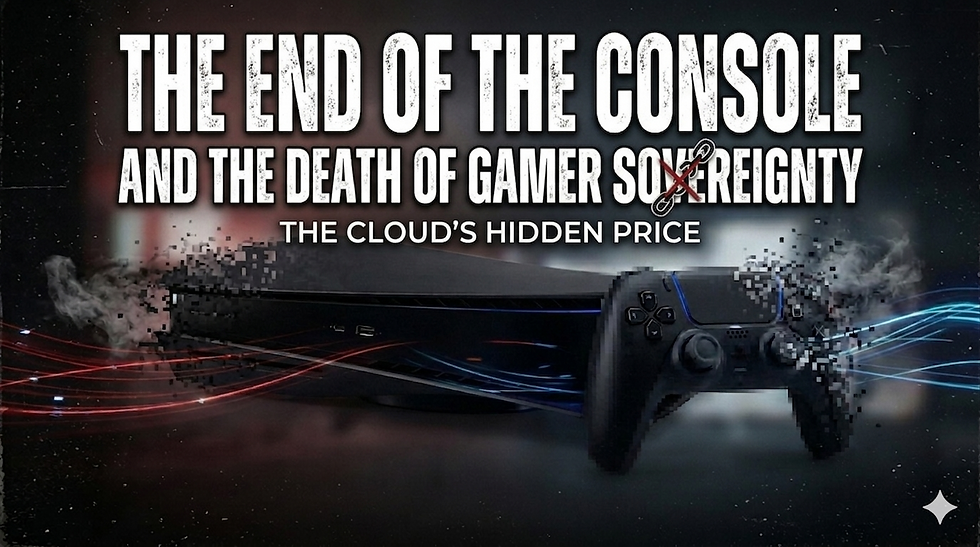
"Recently, information published by the MixVale portal (in an article dated April 10, 2026), indicating that Sony is considering ending its traditional hardware division to focus on digital and cloud services, has raised a red flag throughout the community. More than a simple platform change, what we are witnessing is a tactical move that aims to drastically alter how we consume, own, and preserve games. This transition hides nuances that go far beyond the "practicality" sold by marketing; it touches on the autonomy of those who truly drive this industry: the average gamer."
The Anxiety of Profit vs. The Reality of the Average Consumer
Companies seek profit, and eliminating physical hardware is the shortest path to that. By eliminating logistics, inventory, and manufacturing costs, giants protect their margins. However, what seems logical in the reports of top CEOs ignores the global reality of those who live on a basic salary or work independently.
Today, access to high-performance and stable internet is a high fixed cost anywhere in the world. By suggesting that "you will no longer need an expensive console," the industry is actually outsourcing the risk and investment. Instead of a physical asset that functions independently in your living room, you become dependent on a vulnerable network infrastructure. If the internet fluctuates, your experience becomes a blur; if it goes down, your investment in leisure ceases to exist, although the subscription fee continues to accrue.
The End of Property and the Ephemerality of the Digital Age
The transition to full streaming is the death of ownership. In the cloud model, the game "dies" when the company decides that the server is no longer profitable. We already see this annual "culling" in sports franchises, where servers are shut down to force migration to the next title.
Without physical media or local processing, the single-player style itself risks becoming obsolete. For a cloud server, it's much cheaper to process a multiplayer match with hundreds of players generating microtransactions than to dedicate exclusive hardware to a solitary journey. Streaming, by its very nature, pushes the market towards rapid disposal.
The Crumb Industry: From the Complete Game to Micro-Consumption
Giants like Konami, EA, Epic Games, and Riot have already understood that real profit is no longer in the sale of a single copy. The focus has shifted to the "crumb industry": offering the game as a free or low-cost entry service and profiting infinitely from small transactions. Streaming is the perfect environment to expand this model, transforming the game into a lifetime rental where the user never owns anything.
The Discarding of Human Talent and the Impact on the Ecosystem
Beyond the impact on the consumer, the end of hardware represents a disaster for the specialized job market. Thousands of AMD engineers, Sony hardware architects, and compatibility developers could find themselves obsolete overnight. It's a dismantling of talent where deep technical knowledge is discarded in favor of the cold maintenance of data centers.
This change also affects influencers. Many professionals support their families by being the voice of these communities and the marketing arm of brands in the physical world. By abandoning the console, the industry alters the livelihood base of these creators, making the work more volatile and dependent on policies that change without warning.
The PC as the Last Safe Haven
In this scenario, the gaming PC consolidates itself as the most lucid investment. Unlike a console focused 100% on the cloud, the PC is a multitasking tool. If the streaming service fails or the gaming market fluctuates, you still have a workstation for work and study. On the PC, autonomy still holds up; on the cloud console, if the service dies, the device loses its only reason for existing.
Conclusion: Outsourcing Risk
The end of consoles is a tactical maneuver to protect corporate profits by transferring infrastructure responsibility to the consumer. The giants keep the subscription revenue, while the average gamer bears all the physical and financial risk.
The PlayStation 6 may even reach the market due to scheduling issues, but it marks the beginning of an era where the convenience of access is being traded for the definitive loss of our sovereignty as gamers and collectors of stories.
🛠️ Build your safe haven: Amazon offers
While physical hardware remains our refuge, check out some curated offers to ensure you're in control of your entertainment, without relying solely on the cloud:
By purchasing through these links, you help support our independent analysis work!

Comments